I work in a large school district where we are fortunate to have 1:1 devices for students. Through the use of iPads, teachers are able to incorporate technology into their lessons to increase student engagement. This has been a great tool for some teachers, however, for others it has created more work for them. Learning how to use the technology effectively has been a hurdle that some teachers can not get over.
Through the ADL program I have studied that it is not only about the learning, it is about learning through creating significant learning environments where students are given voice, ownership, and voice through authentic learning opportunities. Also referred to as CSLE+COVA (Harapnuik, n.d.)
Through my Innovation Proposal, I have designed a plan to implement Blended Learning into the primary classroom using the Station Rotation Model as a way to teach Social Studies. One of the goals with my proposal is to help students connect their learning, not just collect information that they later forget. Seth Godin refers to it as “connecting dots, not collecting dots” (Godin, 2012). My Innovation Proposal will be implemented over the course of 15 months. The BHAG (Big Hairy Audacious Goal) of my Innovation Proposal is my overarching goal that I hope teachers can achieve by the end of the 15 months.
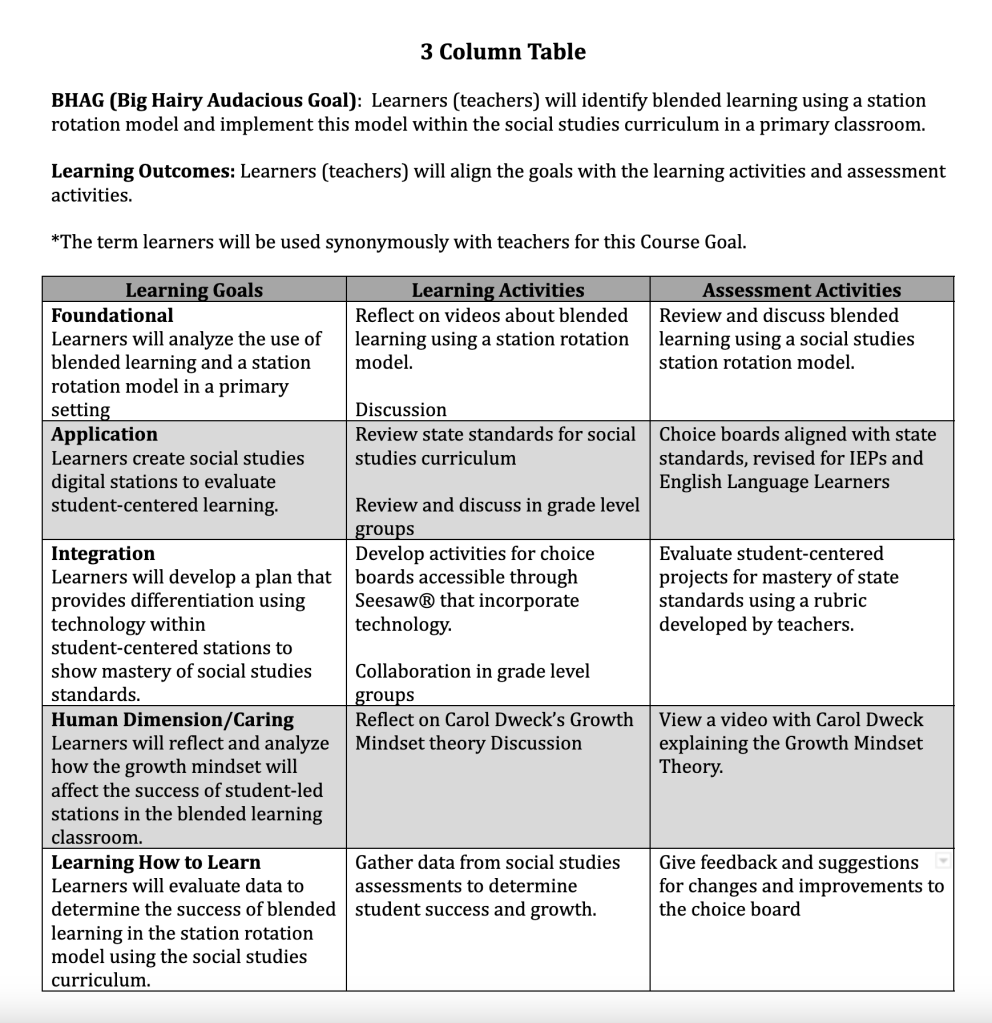
Learning Outcomes 3 Column Table
BHAG (Big Hairy Audacious Goal): Learners (teachers) will identify blended learning using a station rotation model and implement this model within the social studies curriculum in a primary classroom.
Learning Outcomes: Learners (teachers) will align the goals with the learning activities and assessment activities.
*The term learners will be used synonymously with teachers for this Course Goal.
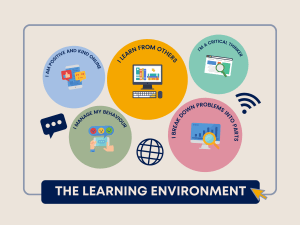
The Learning Environment
Specific Context of the Teaching/Learning Situation
There will be 28-22 students in the primary classroom, grades Kindergarten-Second. The class time allowed for the blended learning station rotation model will be approximately 30 minutes, depending on the grade level. Kindergarten may be less with an average of 20 minutes. The course will delivered using the social studies curriculum. The technology needed will be iPads that are 1:1 for the entire campus. Teachers will have access to 5 additional iPads for students who do not have one and battery packs will be provided for students without a charged device.
General Context of the Learning Situation
The learning expectations placed on this course by the district is the pacing guide that is aligned with the state standards for the state of Texas, also referred to as the Texas Essential Knowledge and Skills or TEKS.
Nature of the Subject
Theoretical learning is what the knowledge is about and the practical application is how the knowledge learned needs to be implemented in certain real-life situations. The subject, since it is based on a social studies curriculum, is a combination of theoretical and practical. The content will be delivered by blended learning in station rotations. With the advancements of technology, there have been significant changes in the field of blended learning as a tool for the implementation of student-centered learning. According to Horn and Staker (2015), blended learning is so important because it is the engine that powers personalized and competency-based learning.
Characteristics of the Learners
The students participating in the blended classroom come from various socioeconomic backgrounds and languages, as well as different levels of learning. Prior knowledge of social studies is sometimes minimal because of the age of the learner and the schema they bring with them. The students will have knowledge of the station rotation model after guided reading has been implemented in the classroom at the beginning of the school year. Students come with knowledge of basic iPad functions and the ability to use Seesaw®, with the exception of Kindergarten.
Characteristics of the Teacher
The beliefs and values of the teacher will play an important role in the implementation of the course. Teachers must develop the growth mindset that allows them to give up some of the control that they are used to when delivering instruction in a whole group setting. According to Caitlin Tucker, the hardest part of blended learning is having the teacher develop an attitude that allows them to give up control and embrace the idea of student-centered learning (Tucker, 2022). The teacher should have a basic level of knowledge for station rotation, how to create choice boards, rubrics, and complete knowledge of the state standards for their grade level social studies curriculum. Strengths of the teacher will need to be the ability to maintain classroom management so that the blended learning environment is successful.
Significant Learning Goals
A year (or more) after this course is over, I want and hope that students will be creating their own authentic projects within the social studies curriculum using the blended learning station rotation model. I hope that the teachers will be able to continue to implement the use of station rotations to teach the social studies curriculum so that students may take ownership over their learning. I hope that teachers will begin to use this model for other content as well.
My Big Harry Audacious Goal (BHAG) for the course is: Learners (teachers) will identify blended learning using a station rotation model and implement this model within the social studies curriculum in a primary classroom.
Foundational Knowledge
The key information important for teachers to understand and remember in the future are:
- blended learning
- station rotation
- rubric
- classroom management
The key ideas that are important for the teachers to understand are:
- growth mindset
- student-centered learning
Application Goals
It is important that teachers are able to think critically so that they can evaluate the success of the implementation of the blended learning station rotation model in their classroom. Teachers need think creatively in order to develop choice boards that give students choice, ownership and voice through their authentic learning opportunities. It is also important that teachers are able to think practically so that they are able to implement a choice board that contains activities that are specific to the students’ needs.
Teachers need to gain a knowledge of using Seesaw®, iPads, and other student accessible apps in order to help the students when necessary. Teachers need to have knowledge of creating and grading with a rubric. Teachers will not need to learn how to manage or create complex stations in order to maintain the station rotation model.
Integration Goals
Teachers should be able to make connections with the blended learning station rotation model to the stations they are already implementing in their guided reading block. Teachers should also recognize the connections to student-centered learning through teaching practices such as collaboration, turn and talks, group projects, Kagan Structures®, and the implementation of Learning Intentions and Success Criteria.
Human Dimensions Goals
One of the things I hope teachers participating in this course will learn about themselves is the ability to give some of the learning back to the students. I hope they will be able to see the value in creating significant learning environments which give students choice, ownership and voice through authentic learning opportunities.
Caring Goals
I hope the teachers will see the value in students taking ownership over their learning. I hope teachers will adopt the growth mindset in their own classrooms after seeing the success of the students.
“Learning-How-to-Learn” Goals
I would like for the teachers to embrace the idea of CSLE+COVA (Harapnuik, n.d.) as well as the Growth Mindset Theory (Dweck, 2014). I would like to see primary teachers embrace the student-centered learning environment with the incorporation of technology so that they can guide their students to become self-directed learners. I would like to see the teachers learn to give up control of the teacher-led classroom environment and learn how to manage a blended learning station rotation model in their daily classroom in order for them to utilize their time so they can help those who may need direct teaching through small group interventions.
References
Godin, S. (2012, October 16). Stop stealing dreams. Retrieved February 11, 2023, from https://www.youtube.com/watch?v=sXpbONjV1Jc&t=12s
Harapnuik. (n.d.). CSLE + COVA. https://www.harapnuik.org. Retrieved February 11, 2023, from https://www.harapnuik.org/?page_id=6988
Horn, M. B., & Staker, H. (2015). Blended. Jossey-Bass.
Stanford Alumni. (2014). Developing a Growth Mindset with Carol Dweck. YouTube. Retrieved February 11, 2023, from https://www.youtube.com/watch?v=hiiEeMN7vbQ.
YouTube. (2022). Question: What is the Hardest Step in the Transition to Blended Learning. YouTube. Retrieved February 11, 2023, from https://www.youtube.com/watch?v=7UeqV_WKXn4.
 Blended Elementary