“For the things we have to learn before we can do them, we learn by doing them.”
~Aristotle
I consider myself a lifelong learner with an insatiable need to learn about anything, especially if I become interested in it. In my late twenties, I still had a strong desire to write a fiction novel, but I did not know where to begin. I read books, studied the writing of famous authors, attended seminars, joined writing groups, collaborated with other writers, and practiced with many rejected manuscripts. Twenty years later, I finally sold a novel to a major publisher. Through the desire to learn, the willingness to study, and learning through failure, I was able to achieve my goal.
There was a time when I did not feel like a learner, or at least a successful learner. It was during my high school years when I realized I was not as smart as most of my friends. I was not sure if learning was complicated for me or if I just was not smart enough to learn a certain curriculum. However, I came to realize that listening to a lecture, taking notes, and memorizing content to pass a multiple-choice test was something I could do well enough to earn a passing grade–even if I never actually learned the content. Learning to apply my learning relevantly was not something I was good at, however, I later discovered that my greatest asset was my willingness to learn, even from my failures.
Failure is instructive. The person who really thinks learns quite as much from his failures as from his successes.
~John Dewey
A Learning Philosophy
Throughout my teaching career I have been an advocate for differentiation because I know first-hand as a learner that not all students learn the same way. I enjoy giving students the freedom to learn in a way that makes them successful. Learners can learn best through hands-on experiences and emotional connections. This is where true learning happens (TEDx, 2019). The basis for my learning philosophy lies with one of the most popular learning theories. The three well-known theories are Constructivism, Behaviorism, and Cognitivism.
Constructivism is a learning theory that is based on the belief that knowledge is best gained through reflection and active construction in the mind (Mascolo and Fischer, 2005).
Behaviorism is probably most well-known for its connection to Ivan Pavlov and his research with conditioning dogs to respond to auditory stimuli. His work concluded that behavior is learned from the environment, it must be observable, and that all behaviors are a product of the formula stimulus-response (Brau et al., 2017).
Cognitivism focuses on the ability of students to guide their own learning using mental strategies. This theory is believed to have stemmed from the inadequacies of the behaviorist learning theories that include strict stimulus and response training (Michela, 2018). Cognitivist believe that encoding, which is the process of us using organization, elaboration and schema (Schunk, 2012, p. 187). This theory also lends itself to the Cognitive Load Theory which proposes that a finite amount of information can be processed at one time, based on perception, attention, and working memory (Schunk, 2012, pp. 223-224).
Teaching Versus Learning
It is my belief that the difference between my learning and teaching philosophy is that my learning philosophy is how I believe we learn. It is the way we process and apply the knowledge we acquire. My teaching philosophy is my perspective on how I present and facilitate the content regarding my beliefs on how my students learn best.
There is no one definition of learning that theorists can agree on, but the main point of agreement is that learning is important. (Shuell, 1986) In looking at the different learning theories, I am intrigued by the philosophies of earlier theorists and how distinctive their beliefs are as well as their definitions of learning. As times have changed and technological advances have reformed and reshaped the classrooms, I have developed a philosophy of learning that incorporates two well-known theories.
I am a Constructivist
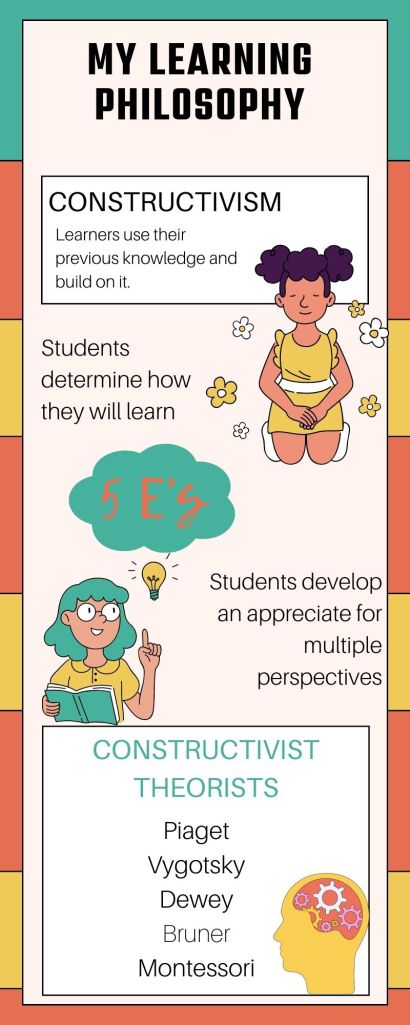
Popular constructivist theorists are Jean Piaget, Lev Vygotsky, John Dewey, and Jerome Bruner. Constructivism is a learning theory that focuses on student-centered learning and engagement. According to Jean Piaget, his theory states that cognitive development progresses in stages. He proposed that learning is a dynamic process made up of consecutive stages of adaptation to their surroundings where the learner actively builds knowledge (Piaget, 1968). Research shows that young students struggle with math when they have not reached the appropriate cognitive stage of development to meet the curriculum (Ojose, 2008).
Bruner states that“The concept of prime numbers appears to be more readily grasped when the child, through construction, discovers that certain handfuls of beans cannot be laid out in completed rows and columns. Such quantities have either to be laid out in a single file or in an incomplete row-column design in which there is always one extra or one too few to fill the pattern. These patterns, the child learns, happen to be called prime. It is easy for the child to go from this step to the recognition that a multiple table, so called, is a record sheet of quantities in completed multiple rows and columns. Here is factoring, multiplication and primes in a construction that can be visualized.” (Bruner, 1973)
As a math teacher, I can relate to this learning theory as I know my students struggle when they are not developmentally prepared for the pace of the curriculum. Constance Kamii, a Constructivist who studied under Piaget, developed an early childhood math curriculum based on Piaget’s Constructivist approach to learning. She explains constructivism as it “refers to the fact that knowledge is built by an active child from the inside rather than being transmitted from the outside through the senses” (Kamii, 1982).
Vygotsky is a Constructivist who developed the Zone of Proximal Development, also known as ZPD. Vygotsky defined this as “the distance between the actual development level as determined by independent problem solving and the level of potential development as determined through problem solving under adult guidance or in collaboration with more capable peers” (Vygostky, 1978, p. 86).
John Dewey combines Piaget’s focus on the cognitive with Vygotsky’s focus on social learning (Brau et.al., 2018). Dewey believed that education should include socially engaging learning experiences that are developmentally appropriate for young learners (Dewey, 1938). Learner-centered classrooms are evidence of Dewey’s social learning theories. Children are seen learning by doing through a hands-on approach. This theory bridges a connection to my Innovation Plan where I have created a significant learning environment for my students by giving them choice, ownership, and voice through an authentic learning opportunity, also known as CSLE+COVA (Harapnuik, n.d.).
Maria Montessori took all of these theories and culminated them into practice and built an entire method around it (TEDx, 2018). This method of education is based on self-directed learning that is hands-on and collaborative. Children make creative choices with their learning. These types of classrooms are for children ages birth to twelve (What Is Montessori Education?, n.d.).
Connecting to My Innovation Proposal
My learning philosophy is well-connected to my Innovation Proposal. Through my Blended Learning proposal in the elementary classroom using a Station Rotation model, my students will be given a chance to use the content they are learning by working at their own pace, collaborating and choosing the project to turn in for an assessment. The hands-on learning environment will allow the students to take ownership of their learning and give them a voice which allows them to discuss what they have learned with peers.
Conclusion
Why is it important to have a learning philosophy? As an educator, I believe it is crucial to know how my students learn and develop, as well as identify how I learn. The more I know about learning, the more I can connect with my students. Those connections to their learning gives me a stronger ability to create a significant learning environment that will give my students choice, ownership, and voice through authentic learning opportunities.
 Blended Elementary