Accepting change is never easy. Some people are better equipped to roll with the flow while others will resist to the bitter end. If accepting change is hard in general, being the person who is creating the change, or executing it, creates a whirlwind (Huling et al., 2012). People often get caught up in the day-to-day busy work schedule and, while they feel overworked, they actually have not accomplished anything that gets them closer to their goal.
After reading the 4 Disciplines of Execution by Chris McChesney, Sean Covey, and Jim Huling, I have created a plan that will work in conjunction with my Influencer Strategy to implement change in my organization through my Innovation Proposal.
Discipline 1
Focus on the Wildly Important Goal
The WIG—90% of K-2 teachers will use blended learning with choice boards to teach social studies by the end of the 2023-2024 school year.
It’s so easy to focus on a million other things when trying to complete a goal. The WIG is maintain focus. Without establishing the WIG, it is too easy to focus on the smaller things that come up and lose sight of what is important. What we want is to have at least 90% of teachers using blended learning to teach social studies in the Kindergarten, First, and Second grade classrooms.
Discipline 2
Act on the Lead Measures
This discipline is focuses on the actions that have the most impact. The progress and success of my implementation proposal is based on two measures: the lag and lead.
The lag measures will track the measurement of the WIG. The performance of this is already in the past. This data will show us if we have been successful teaching social studies in a blended learning station rotation environment.
Lead measures are those that will measure the most impactful thing that must be done to reach the goal.
Lag: Social studies common unit assessments, daily grades, and common formative assessments will determine if students are successful with their blended learning stations.
Lead measure 1 Use Google Drive to have a place where teachers can work collaboratively on grade level choice boards for each unit of study.
Lead measure 2 Invite the Technology Integration Specialists to help with technology integration within the social studies state standards.
Discipline 3
Keep a Compelling Scoreboard
This discipline involves engagement. People will engage when they feel there is a purpose. When people become emotionally engaged, performance level increases. Simply put, people need to know the score so they can stay in the game. Now we need to have a way to show teachers where we are with our goal.
The Scoreboard
Teachers are in it for the kids. Ultimately, that’s the WIG of our profession. Rather than keep a scoreboard of the teachers who are participating in the WIG, we will create a scoreboard that shows how students are successful with blended learning stations. We will do this by having teachers participate in keeping the scoreboard. Teachers will share photos of student projects to a Google file so that all teachers can see students being successful. Teachers will also graph the number of students who showed growth on unit assessments after the implementation of blended learning stations.
Discipline 4
Create a Cadence of Accountability
This is where execution takes place. This is the where we have to hold each other accountable so that we don’t lose focus of the wild important goal. It is often the most dreaded discipline in the teaching profession: the meeting.
Without regular meetings where goals are discussed, it is easy to forget about the WIG. To help maintain a cadence of accountability, teachers will discuss the successes or problems with the WIG each week at their planning and PLC time.
What Comes Next?
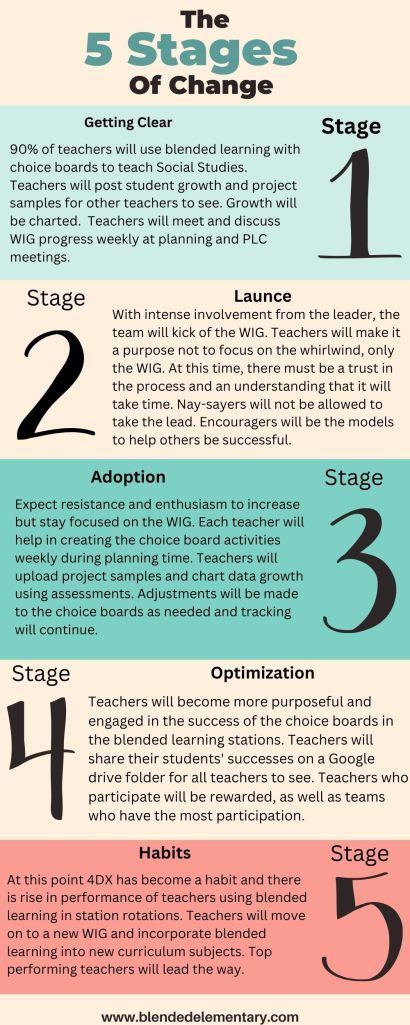
When installing the 4DX with my team, there will be challenges and expectations that arise. After installing the four disciplines, the 5 stages of change can be expected.
Bringing it All Together
When comparing the Influencer Model and the 4DX model in relation to my Innovation Plan, I am leaning more toward the Influencer Model due to the personal and social component. However, 4DX provides a strategic plan for implementing goals. As challenging as it is to implement change, I feel that finding a balance between the two strategies would be a great way to kick off my Innovation Proposal
References
Grenny, J., Patterson, K., Maxfield, D., McMillan, R., & Switzler, A.. (2013). Influencer: The new science of leading change. New York, NY: McGraw-Hill Education.
McChesney, C., Covey, S., & Huling, J. (2016). The 4 disciplines of execution: Achieving your wildly important goals. New York: Free Press.
 Blended Elementary