An Effective Way to Teach Teachers
My Experience
I’ve been in education for over twenty years. During that time I have attended many professional development sessions. Some were good, some were not, and some so amazing that I could not wait to bring what I had learned back to my classroom. Ultimately, what happened next was a common outcome for most teachers. It was difficult to implement with my students, I had no follow-up training, and in the end set it aside out of frustration. It was easier to go back to something I was already doing, something familiar.
A professional consensus is emerging about particular characteristics of “high quality” professional development. These characteristics include a focus on content and how students learn content; in-depth, active learning opportunities; links to high standards, opportunities for teachers to engage in leadership roles; extended duration; and the collective participation of groups of teachers from the same school, grade, or department.
(Desimone, et. al., 2002)
The Real Problem
Studies show that this outcome is the norm for professional learning (Gulamhussein, 2013). Teachers are doing required professional development only to return back to their classroom to teach with the strategies that they are comfortable with. Is this the fault of the teacher? Or was the professional development implementation flawed? Before we can answer that, we need to dive deeper and think about the learning. Schools often focus on how students learn and the strategies teachers need to best teach them. However, when planning professional development, schools seldom think about how teachers learn. Teachers need collaborative, hands-on learning as well. Now, let us shift our focus to the teacher as the student. So, where do we go from here?
Currently
Our current standard of professional development is implemented in a sit and get format as the daylong inservice model. The teacher listens to a presenter or coach discuss a new innovative strategy, the teacher jots down some notes, brings home some handouts, then tucks them in a folder and breathes a sigh of relief because another requirement can be checked off the list. Or the teacher tries to implement the new strategies without much success because there was not enough training, and the strategy does not work. As a teacher, I know this to be true. I have lost track of how many times I have done the same thing over the past twenty years. But this is where schools need to make the shift when it comes to professional learning. Schools need to do better. When we afford the teacher the opportunity to learn new teaching strategies while giving them the ability to fully implement them in the classroom, ultimately we are helping our students become more successful.
Creating Change
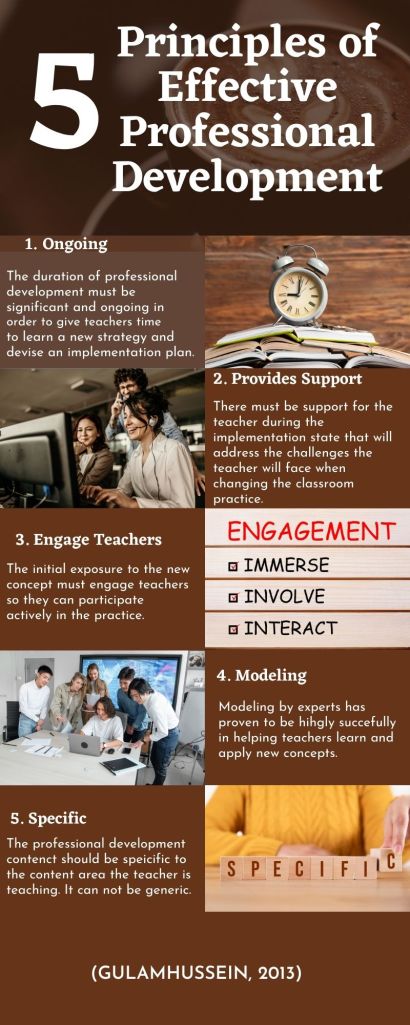
How do schools create a change in the implementation of professional learning? The solution is based on research. It focuses on finding effective professional development that truly changes the way teachers work and the learning of students. When teachers receive well-designed professional development, an average of 49 hours spread over six to 12 months, they can increase student achievement by as much as 21 percent (Yoon, Duncan, Lee, Scarloss, and Shapley, 2007). In much the same way it takes multiple exposure for our students to master a new skill or concept, it takes teachers, on average, twenty instances of practice to master a new teaching concept (Joyce & Showers, 2022), while other studies have shown it to be closer to 50 hours (French, 1997). We can no longer sit back and ignore the facts. Schools need to do something different. There needs to be a change. Creating an alternative, effective model of professional development is based on five principals (Gluamhussein, A. (2013).
- Professional development must be ongoing
- Must have support for the teacher
- Initial exposure for the teacher must not be passive–the teacher must be engaged in active participation
- New practices must be modeled for the teacher
- The content must be relevant to the teacher’s content or grade level.
Conclusion
In order for districts to provide successful models of professional learning for teachers, we have to recognize that teachers learn much the same way that students do. When teachers are first introduced to a new concept or teaching skill, the learning should be hands-on and active. The learning must be ongoing with coaches and lead teachers facilitating professional learning communities. This is where teachers collaborate, share ideas and techniques, and determine what is working and what is not. In summary, teachers need engaging, content specific Professional Learning opportunities with modeling that provides significant and ongoing support. If we want to see an increase in student achievement, we must empower our teachers with the tools they need to make it happen.
References
Desimone, L. M., Porter, A. C., Garet, M. S., Yoon, K. S., & Birman, B. F. (2002). Effects of Professional Development on Teachers’ Instruction: Results from a Three-Year Longitudinal Study. Educational Evaluation and Policy Analysis, 24(2), 81–112. http://www.jstor.org/stable/3594138
Edutopia. (2017, April 6). Teacher Labs: Making Professional Development Collaborative. In YouTube. https://www.youtube.com/watch?v=gf5KcyHGhRA
French, V. W. (1997). Teachers must be learners, too: Professional
development and national teaching standards. NASSP
Bulletin, 81, 38–44.
Gulamhussein, A. (2013). Teaching the Teachers Effective Professional Development in an Era of High Stakes Accountability. Center for PUblic Education. Retrieved from http://www.centerforpubliceducation.org/system/files/2013-176_ProfessionalDevelopment.pdf (https://www.dropbox.com/sj13c5mk092kmq9/Teaching_Effective_Professional_Development.pdf?d!=0)
Joyce, B & Shower, B (1982) The Coaching of Teaching. Educational Leadership, 40 (1), 4-10.
Yoon, K. S., Duncan, T., Lee, S. W.-Y., Scarloss, B., & Shapley, K. (2007). Reviewing the evidence on how teacher professional development affects student achievement (Issues & Answers Report, REL 2007–No. 033). Washington, DC: U.S. Department of Education, Institute of Education Sciences, National Center for Education Evaluation and Regional Assistance, Regional Educational Laboratory Southwest. Retrieved from http://ies.ed.gov/ncee/edlabs
 Blended Elementary