Final Draft for Article Submission
Theresa Hall
EDLD 5317
April 23, 2023
Before the implementation of blended learning during the recent pandemic, teachers had never imagined teaching in an exclusively digital environment. It created a whirlwind of stress, not only with teachers, but with students and their parents as well. Today, many schools are still using 1:1 technology in the classroom, but teachers are still struggling to adapt. How can we use the technology in a traditional primary classroom? Even though younger students are far more advanced in their technological skills than ever before, teachers have to find a balance to use it successfully. It has to be easy for the students to use independently, yet powerful enough to support the curriculum.
Seesaw Learning App
One of the best tools I have found for implementing blended learning in the primary classroom is Seesaw. The app can be used on an iPad, tablet, or computer, which makes it extremely versatile for use in and out of the classroom. Lessons can be created by the teacher or accessed through the Seesaw Learning Library, where Seesaw Ambassadors share ready-made lessons. One of the great tools Seesaw has is the ability to attach links to lessons, upload or embed videos, attach a pdf, a picture, and a link to a Google file. Students can record their voice as they work through a math problem or read a passage to the teacher for a running record. There are so many versatile ways to use Seesaw, making it a great tool for blended learning.
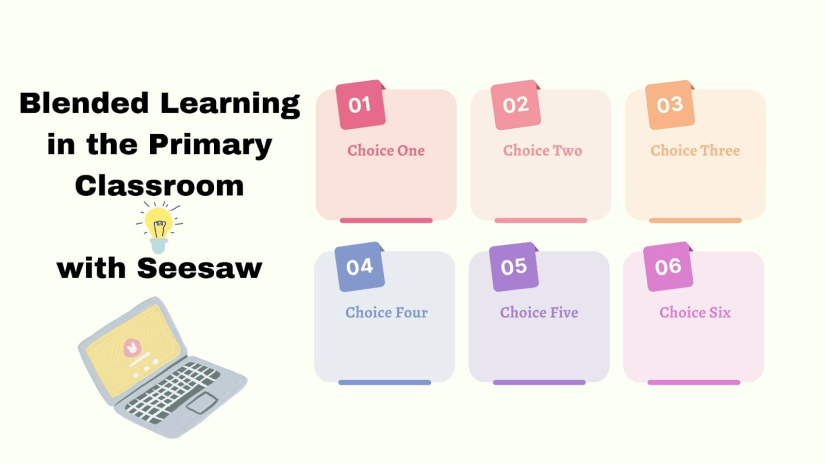
One of the best ways I have used Seesaw for blended learning is through implementing choice boards. Teachers can create one choice board in Seesaw with links to many different activities and lessons. Students are given a choice, ownership, and voice over their learning because they get to choose the lessons they want to submit for mastery.
Reaching All Students through Choice Boards
Teachers always need more time. By implementing blended learning with Seesaw in a station rotation model, it will allow teachers to find time to pull small groups, provide enrichment, and give struggling students the extra support they need. Teachers can use choice boards within Seesaw to provide lessons that are written for students who have IEPs, for English Language Learners (ELLs), and to provide enrichment.
First Hand Experience
When I changed from departmentalized to self-contained, guided reading stations were a struggle for me. The students were engaged in the stations, but they saw them as a social time and were easily off task. My stations were lacking student accountability.
I first heard about Seesaw at a literacy training in my district and I could not wait to use it. I took an old iPad from home and put it in a central location for the students to share. When their stations were completed, they used the Seesaw app to take a picture of their work and upload it to their personal journal for me to check. Guided reading was suddenly a quiet time of learning. Students were now taking accountability for their work.
I am currently teaching second grade in the gifted and talented program. I recently used Seesaw to implement a choice board with magnets. Through freedom of choice, some students wrote about magnets, drew pictures, or made a magnet board game. Through a station rotation, students viewed extension videos, read books, and looked at pictures of different magnets before completing their project. As they worked at their own pace, my time was used to help students who needed direct teaching. It was a win for all.
How to Begin
If a district does not offer Seesaw, there is a free basic account for teachers to use. This is where I started and it worked wonderfully. For teachers who are not sure where to find choice boards, there are some great resources in the Seesaw lesson library that can be saved and modified.
By creating significant learning environments through blended learning, teachers are giving students a choice, ownership, and voice over their learning. Teachers can give the students the opportunity to take accountability for their learning. Allowing students to move through a station rotation model gives teachers the ability to reach every student, every day.
References
Edpuzzle. (2021 13). What is the Station Rotation Model? YouTube. https://www.youtube.com/watch?v=tgr3lnCl5QY
Horn, M. B., & Staker, H. (2015). Blended. Jossey-Bass.
Tucker, C. (2022, December 3). FAQ: The Station Rotation Model. Dr. Catlin Tucker. Retrieved March 15, 2023, from https://catlintucker.com/2022/12/faq-station-rotation-model/
Elevate learning in elementary. Seesaw. (n.d.). Retrieved March 15, 2023, from https://web.seesaw.me/
BIO
Theresa Hall has been a certified teacher for 27 years and loves keeping up with the ever-changing world of technology. She is working on a Master of Education Degree in Applied Digital Learning.
 Blended Elementary
1 thought on “Final Draft”