When I was in high school I struggled with math, particularly algebra. I can remember constantly asking, “Why it done this way?” and “What am I learning this for?” I had the hardest time investing myself into something I could not see a purpose for. As a teacher, this is often something I remind myself of when I am teaching my students. Making real-world connections to their learning helps answer the question why so they can better understand the purpose in what I am teaching them.
Simon Sinek says, “People don’t buy what you do, but why you do it” (Sinek, 2013). He states that very few people know their why. It is easy to tell people what they want, but it is much harder to tell people why they need something. My Innovation Plan proposes implementing blended learning using a station rotation model that incorporates choice boards. Here is the Why, How, and What behind my Innovation Plan.
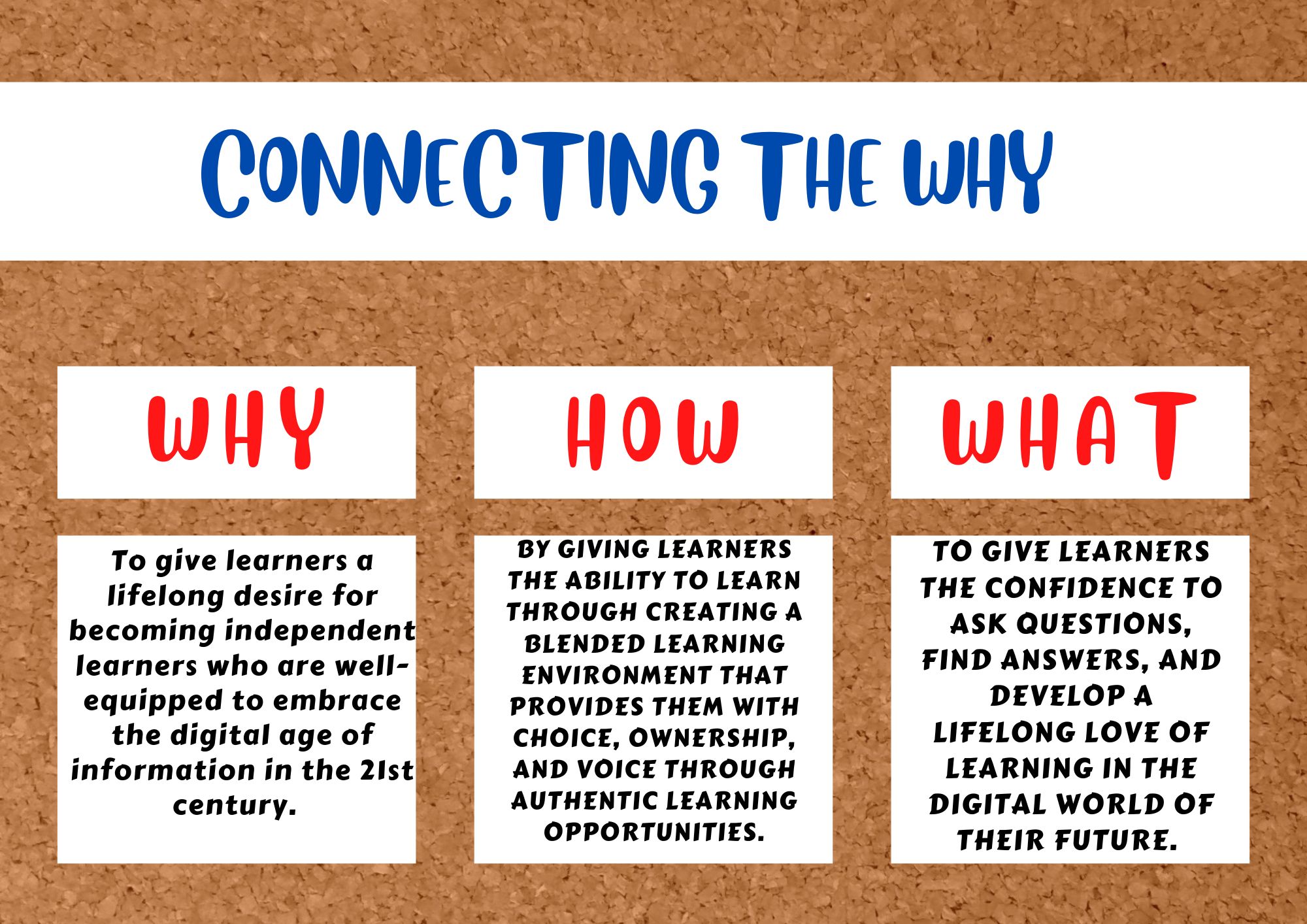
Why—To give learners a lifelong desire for becoming independent learners who are well-equipped to embrace the digital age of information in the 21st century.
How—By giving learners the ability to learn through creating a blended learning environment that provides them with choice, ownership, and voice through authentic learning opportunities.
What—To give learners the confidence to ask questions, find answers, and develop a lifelong love of learning in the digital world of their future.
Just Tell Me Why?
As educators we all want to build our students into lifelong learners. We want to ignite a fire in them that gives them a desire to go out into the world as independent learners. Our students are growing up in the age of information that innovative technology has brought about. Everything they want to know is at their fingertips, and they know how to find it. But we have to ask ourselves if we are truly preparing them to be independent learners in the 21st century. Are we allowing them to grow into the learners they need to be to thrive in the world in which they are growing up in, and possibly one day be the leaders of. Are we creating independent learners and thinkers? Or are we showing them that technology is not important for their future?
But How?
John Kotter stated that people make decisions based on facts, but they only do it if supports their truth (Kotter, 2013). As teachers, we have to ask ourselves what our truth is. Mine has always been to help my students become lifelong learners. Through blended learning and the station rotation model, not only will students be able to learn through the use of technology, they will be given the opportunity to have a choice over their learning through authentic projects, a voice over how they show their learning, and the ability to show ownership over their own learning.
What?
Teachers are accustomed to having their classrooms used as experimental laboratories for the next new idea. We go to professional development to learn how to implement it, and if we are honest, we even get excited about using it—until the next new idea comes along. So what makes blended learning so different than the other innovative ideas of the past? The most important reason is because it utilizes a teaching practice we already know how to use, the station rotation, and combines it with technology we already have in our classrooms. Through blended learning we can achieve our purpose of creating lifelong learners who are ready to face the technology-rich world that awaits them when they leave our classrooms.
References
Kotter, J. (2013, August 15). Leading change: Establish a sense of urgency. YouTube. Retrieved March 10, 2023, from https://www.youtube.com/watch?v=2Yfrj2Y9IlI
Sinek, S. (2019 28). Start with why — how great leaders inspire action. In YouTube.com. https://www.youtube.com/watch?v=u4ZoJKF_VuA
The Behavioral Science Guys. (2015, January 5). How to Change People Who Don’t Want to Change . In Youtube.com. https://www.youtube.com/watch?v=9ACi-D5DI6A
 Blended Elementary
1 thought on “Connecting the Why”